

Inside Ethiopia’s State-Media Campaign Against Eritrea

Ethiopia’s state broadcaster has crossed another dangerous line.
Then again, this is not new. And it almost certainly won’t be the last time.
For months, EBC’s Amharic-language output has been full of this kind of messaging — blunt, emotional, territorial, and clearly aimed at a domestic audience. The English-facing material is usually softer. It tends to be polished just enough to confuse outsiders, diplomats, and foreign observers into thinking this is all just a conversation about trade, economic need, or regional access.
In Amharic, though, the difference is harder to miss.
There, the message is far more direct. What gets packaged in English as “sea access” is often presented at home as grievance, entitlement, and historical claim. That double talk matters. And what we are exposing here is only the surface of it.
The latest example is EBC’s post describing Assab as “a debt of history” and “the horizon of Ethiopia’s freedom.” Those are not innocent phrases, or neutral reflections on ports, trade routes, or regional cooperation. They are political slogans, crafted to plant a sense of ownership in the public mind and to make a claim over sovereign Eritrean territory sound normal.
At that point, this stops looking like journalism and starts looking like something far more dangerous: an effort to prepare the public to accept a territorial claim against Eritrea.
Assab is not “lost Ethiopian land.” Assab is Eritrean territory. It is part of the sovereign State of Eritrea, whose independence was overwhelmingly confirmed by its people in the 1993 referendum under international observation.
The legal and historical record is not complicated, no matter how much EBC tries to muddy it. Eritrea was federated with Ethiopia under UN General Assembly Resolution 390 A(V) in 1950 as an autonomous unit, not as some ordinary Ethiopian province. Even that arrangement recognized Eritrea’s separate status, institutions, and identity. Ethiopia later dismantled the federation by force, which in turn triggered the thirty-year liberation struggle. Eritrea did not casually “break away” from Ethiopia. It restored a sovereignty that had been denied.
That is why the EBC effort to recycle old colonial-contract arguments around Assab and the Rubattino Company is so dishonest. It tries to suggest that selective references from the nineteenth century somehow cancel the modern international order. They do not. What is being presented as legal reasoning is really historical revisionism dressed up as argument.
And even if one sets aside the older history, the more recent legal record is just as clear. After the 1998–2000 war, the Eritrea-Ethiopia boundary issue was submitted to an independent commission established under the Algiers Agreement. The Eritrea-Ethiopia Boundary Commission issued its delimitation decision in 2002, and both sides accepted it as final and binding.
So what, exactly, is EBC contesting?
At bottom, it is not really contesting history, law, or geography. It is contesting Eritrea’s sovereignty.
The wording gives the game away: “a debt of history,” “Ethiopia’s freedom,” “who betrayed her?” These are not neutral terms. They are mobilizing phrases. They are designed to stir grievance, resentment, and entitlement inside Ethiopia at a time when the public is already being fed increasingly dangerous narratives about the Red Sea.
This fits a broader pattern under Abiy Ahmed’s government. Commercial access is repeatedly blurred with sovereign ownership. Economic need is repackaged as historical entitlement. A practical issue that could be handled through normal diplomacy is transformed into a nationalist mission, as though the Red Sea were somehow Ethiopia’s destiny to claim rather than a regional space to engage through law and mutual respect.
That is a reckless way to frame a matter that should, in any serious regional setting, be handled through diplomacy and respect for sovereignty.
No country is denied the right to trade. Eritrea has never argued against lawful commercial access based on sovereign equality and negotiated agreement. But there is an obvious difference between using a port through mutual arrangement and claiming another country’s coastline as a historical right. One is diplomacy. The other is aggression in waiting.
The EBC post also praises the Derg’s investment in Assab, as if infrastructure built under illegal rule created permanent ownership. That argument falls apart the moment it is tested.
Asmara is still called “Little Rome” because colonial Italy left behind architecture, roads, and urban planning that shaped the city’s image. Yet not even Italy would dare claim Asmara - or Eritrea itself - on the basis of what it built during colonial occupation. So by what logic does Ethiopia’s criminal Derg regime, which destroyed far more in Eritrea than it ever built, suddenly acquire a sovereign right over Assab because it used the port for its own military and economic purposes?
Building infrastructure does not create sovereignty, and occupation does not confer title. Nostalgia for an illegal past does not become a legal claim simply because a state broadcaster repeats it often enough. If anything, the historical ledger runs in the opposite direction: Ethiopia owes Eritrea accountability and compensation for decades of illegal annexation, military destruction, economic exploitation, and the enormous human cost imposed on the Eritrean people.
Assab’s infrastructure under the Derg was built during Ethiopia’s illegal rule over Eritrea. It does not transform Eritrean territory into Ethiopian property. If anything, it reminds Eritreans of the period when their land, ports, and people were controlled by a state that denied their right to exist as a nation.
That is why this kind of propaganda has to be taken seriously. Not because Eritrea fears rhetoric, but because rhetoric from a state broadcaster is rarely accidental. It helps shape public sentiment, test political boundaries, and signal direction. And when the message is repeated often enough — especially in the harder, more explicit Amharic messaging - it becomes part of a broader effort to normalize hostility toward Eritrea and condition the public for confrontation.
The Horn of Africa has already paid too much for imperial fantasies, strategic delusions, and reckless leadership. Ethiopia’s people need stability, jobs, food security, reconciliation, and peace. They do not need another campaign of emotional manipulation built around a coastline that does not belong to them.
Assab is Eritrean by history, by sacrifice, by referendum, by international law, and by lived reality.
No propaganda graphic, no Amharic slogan, and no revisionist essay will change that.
Ethiopia can pursue access to the sea through peace, law, and cooperation. What it cannot do - and what no amount of state-media incitement will legitimize - is lay claim to Eritrean territory.
That line is not negotiable.
Related stories
Ethiopian Regimes and the Fabled Hyena
The preeminent author, historian and tegadalay Alemseged Tesfai brilliantly detailed the “consistently suicidal pursuit of successive Ethiopian regimes to own Eritrea or parts thereof” in his piece titled “March of Folly Re-enacted: A Personal View“. It was published 27 years ago

Abiy Ahmed’s Sudan Game Is Now in Plain Sight
The mask keeps slipping. A new report by Yale’s Humanitarian Research Lab says it has reached a high-confidence conclusion that military assistance to Sudan’s Rapid Support Forces is taking place inside an Ethiopian National Defense Force base in Asosa, in Ethiopia’s Benishangul-

Abiy Ahmed Can’t Hide Ethiopia’s Collapse Behind Diplomacy
You can lie in speeches. You can posture at summits. You can wrap failure in diplomatic language and hope the world only reads the headline. But official travel advisories have a way of cutting through the performance. They are written carefully, especially by countries that have
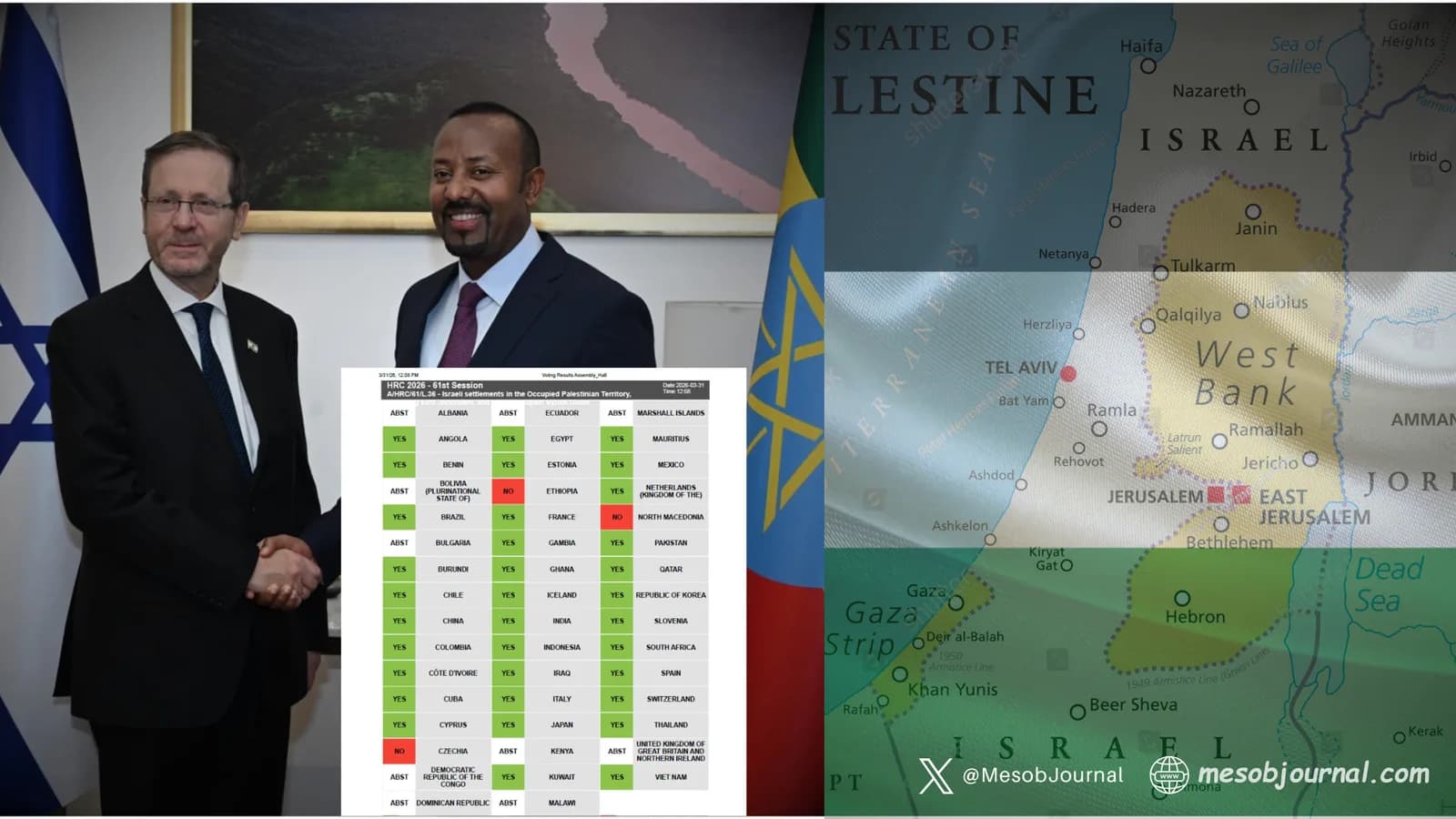
Abiy Ahmed’s Shameful UN Vote Betrays Africa and Palestine
There are votes that expose a government’s priorities more clearly than any speech ever could. Ethiopia’s “No” vote at the UN Human Rights Council on 31 March, against a resolution reaffirming the illegality of Israeli settlements in the Occupied Palestinian Territory and the o